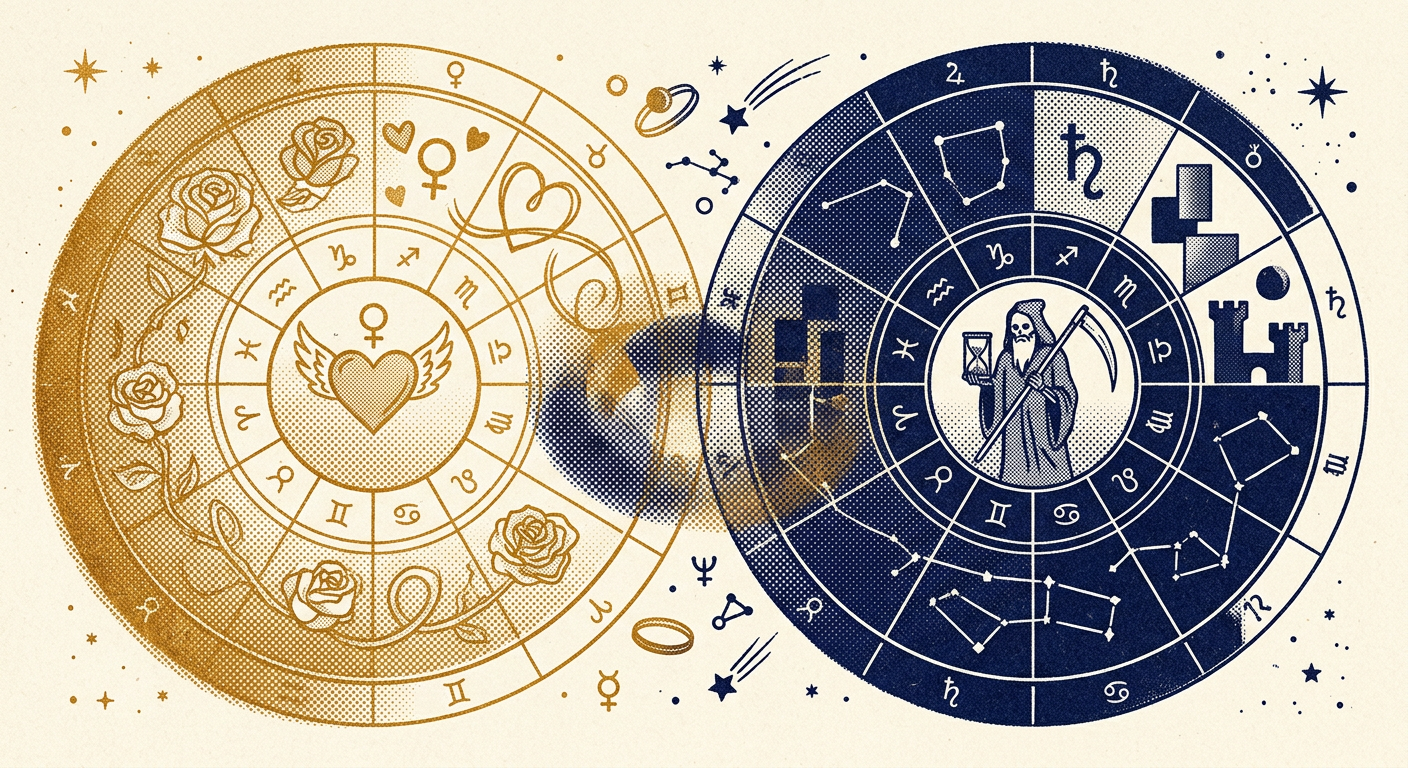
Most people approach a composite chart looking for green flags. They want confirmation. They want a tidy list of placements that spell out 'this is the one.' But composite chart marriage indicators don't work that way — and treating them like a checklist is exactly how people misread charts that are actually quite strong.
Here's the thing: a composite chart is the chart of the relationship itself, not either person. It describes the entity that forms when two people come together. So when you're looking for marriage indicators, you're not asking 'do these people like each other?' You're asking something harder: 'Does this relationship have the structural and emotional architecture to hold long-term commitment?'
That's a different question. And it requires a different way of reading the chart.
Why Marriage Indicators in a Composite Chart Differ From Synastry Signals
Synastry compares two birth charts. It shows how Person A's planets interact with Person B's — attraction, friction, emotional resonance. It's the chemistry layer. You can have explosive synastry with someone you'd never build a life with.
The composite chart is different. It doesn't measure attraction. It measures the relationship's character, purpose, and durability. Two people with mediocre synastry can have a strikingly functional composite chart. Two people with intense synastry can produce a composite chart that looks chaotic and unstable.
So if you're looking for composite chart compatibility marriage signals specifically, you need to be looking at the composite — not just the synastry overlay. Both matter. But they're answering different questions.
For a deeper read on the evolutionary direction of the relationship, how the North Node in a composite chart shapes the relationship's long-term direction is an essential layer to add once you've assessed the core marriage indicators covered here.
The 7th House in the Composite: Commitment as the Relationship's Core Theme
The 7th house in any chart is the house of committed partnership. In a composite chart, it carries the same weight — but now it's describing the relationship's own orientation toward commitment, not either person's individual relationship style.
A heavily tenanted composite 7th house means commitment is baked into the relationship's identity. The relationship itself gravitates toward formalization, partnership, and long-term structure.
Planets in the Composite 7th House and What They Indicate
Not all 7th house planets are equal. Here's what the major placements signal:
- Sun in the composite 7th: Partnership is central to the relationship's purpose. The relationship thrives when there's formal, recognized commitment. This is one of the clearest structural marriage indicators.
- Venus in the composite 7th: The relationship values partnership deeply. There's natural affinity for togetherness, aesthetics of couplehood, and shared social identity. Strong indicator — but needs Saturn contact to move from 'romantic' to 'lasting.'
- Saturn in the composite 7th: The relationship takes commitment seriously. There may be delays or obstacles, but the bond tends toward permanence. This placement often indicates a relationship that was built, not just felt.
- Jupiter in the composite 7th: Expansive partnership energy. Can indicate a relationship that feels fated or fortunate. Less reliable as a standalone marriage indicator — Jupiter expands whatever it touches, including idealization.
- Mars in the composite 7th: High energy, drive, and sometimes conflict in partnership dynamics. The relationship pursues commitment actively but may need other stabilizing factors.
- Moon in the composite 7th: Emotional security is tied to the partnership itself. Strong need for the relationship to be defined and stable.
The Composite Descendant Sign and Partnership Style
The composite Descendant (cusp of the 7th house) describes the style of partnership the relationship seeks. A Capricorn Descendant, for instance, signals a relationship that values structure, responsibility, and long-term building. A Libra Descendant emphasizes balance, social partnership, and aesthetic harmony.
The Descendant sign won't tell you if the relationship leads to marriage. But it will tell you how the relationship approaches the idea of commitment — and whether that approach is realistic or idealized.
Composite Venus: How the Relationship Values Itself
Venus in the composite chart describes what the relationship finds valuable, beautiful, and worth protecting. It's not just romantic energy — it's the relationship's entire value system, including how it treats itself.
Venus in Strong Houses vs. Challenging Aspects
Composite Venus in the 1st, 5th, 7th, or 10th house tends to produce relationships with strong social and romantic identity. The relationship knows what it is and presents itself confidently.
But Venus with challenging aspects — square Pluto, opposite Saturn, square Uranus — doesn't automatically weaken the marriage potential. It complicates it. Venus square Pluto, for example, can indicate a relationship with intense emotional investment and possessiveness. That intensity can fuel long-term commitment as readily as it can fuel conflict.
The key is whether the challenging Venus aspects are accompanied by stabilizing Saturn contacts.
Venus-Saturn Aspects: The Commitment Signature
This is the one I look at first. Venus-Saturn aspects in a composite chart — especially the conjunction, trine, or sextile — describe a relationship that has made a conscious choice to value longevity over ease.
Venus wants pleasure, warmth, and comfort. Saturn wants structure, responsibility, and proof. When they work together in a composite chart, you get a relationship that has decided the work of commitment is worth doing. The trine and sextile versions are easier to live with. The conjunction and square demand more conscious navigation.
But here's what matters: relationships with strong Venus-Saturn aspects in the composite tend to stay. They're not the most effortlessly romantic charts. They're the ones that show up for each other when it's hard.
(I've seen composite charts with Venus trine Neptune that looked gorgeous on paper — full of romance and spiritual connection — but had no Saturn anywhere near Venus or the 7th house. Those relationships often don't survive contact with real life.)
Composite Saturn: Stability, Longevity, and the Price of Permanence
Saturn is the most important planet in a composite chart when you're specifically assessing marriage potential. Not Venus, not the Moon — Saturn.
Why? Because Saturn describes the relationship's capacity for structure, responsibility, and sustained effort. Without Saturn, even beautiful composite charts can feel like they never quite solidify.
Saturn Conjunct the Composite Sun or Moon
Saturn conjunct the composite Sun gives the relationship a serious, purposeful character. There's gravity here. The relationship takes itself seriously, and both people tend to take the partnership seriously in return. It can feel heavy at times — but that weight is structural, not oppressive.
Saturn conjunct the composite Moon is more emotionally complex. The emotional life of the relationship is shaped by responsibility, caution, and sometimes restraint. This can feel cold from the outside. But it often produces profound emotional loyalty — the kind that holds even when the warmth fluctuates.
Hard Saturn Aspects: Obligation vs. Chosen Commitment
Saturn square the composite Sun or Moon is often misread as a red flag. It's not. It's a flag that requires more context.
The question with hard Saturn aspects is whether the relationship feels like a chosen commitment or an obligatory one. That distinction matters enormously for long-term sustainability. A relationship where both people feel trapped by Saturn energy is different from one where they've both consciously decided the structure is worth it.
For context on how individual sign energies affect this dynamic, zodiac signs marriage compatibility chart patterns can add a useful layer to the composite Saturn analysis.
The Composite Moon and Emotional Sustainability
If Saturn is the backbone of the composite chart's marriage potential, the Moon is the nervous system. It describes the relationship's emotional environment — how the two people feel when they're together, whether they feel safe, whether they can actually rest in each other's presence.
A difficult composite Moon doesn't kill marriage potential. But a composite Moon that's under severe stress (multiple hard aspects, placed in a challenging house with no support) often signals emotional instability that makes long-term cohabitation genuinely difficult.
Moon in the 4th House: Building a Home Together
Composite Moon in the 4th house is one of the clearest indicators of domestic compatibility. The 4th house rules home, family, roots, and private life. Moon here says the emotional center of the relationship is the home — the shared private world these two people build.
This placement strongly supports marriage because it means the relationship naturally gravitates toward creating a shared domestic life. It's not just about romance or excitement. It's about building something together that feels like home.
Moon-Saturn and Moon-Jupiter: Contrasting Long-Term Signals
Composite Moon trine or sextile Saturn: emotional stability is built into the relationship. Feelings are taken seriously. There's reliability in the emotional bond even when it's not effusive.
Composite Moon square or opposite Saturn: emotional expression may feel restricted or heavy. Not a dealbreaker — but both people need to actively work on allowing vulnerability rather than defaulting to emotional distance.
Composite Moon conjunct or trine Jupiter: emotional generosity, warmth, and expansiveness. The relationship feels good. But Jupiter-Moon without Saturn support can indicate emotional inflation — the relationship feels better than it actually functions when tested.
For a broader look at how Moon and Venus placements interact in compatibility contexts, Moon sign, Venus, Mars, rising: the four placements that actually drive romantic compatibility offers useful grounding.
Outer Planet Influence: Pluto, Neptune, and Uranus in Marriage Contexts
Outer planets in marriage-relevant composite positions are the most misunderstood indicators. People either over-romanticize them or panic about them. Neither response is accurate.
Pluto in the composite — especially conjunct Venus, the Moon, or placed in the 7th or 8th house — describes a relationship with profound intensity, transformative power, and sometimes obsessive dynamics. Pluto doesn't indicate marriage. It indicates that the relationship cannot stay surface-level. Whether that depth becomes the foundation of lasting commitment or an exhausting power struggle depends entirely on the rest of the chart.
Neptune in the composite — conjunct Venus or placed in the 7th house — creates an otherworldly, romantic, almost spiritual quality to the partnership. It's beautiful. It can also be destabilizing if there's not enough Saturn to anchor it. Neptune-heavy composite charts are prone to idealization, projection, and painful disillusionment when reality intrudes. A composite chart with Neptune prominent and Saturn weak is a chart worth approaching carefully.
Uranus in the composite — especially in the 7th house or aspecting the composite Sun — signals a relationship that resists conventional structure. This doesn't mean it can't commit. But it means the commitment will look unconventional. Trying to force a Uranus-heavy composite into a traditional marriage framework often creates the very instability people fear.
So look: outer planets are not marriage indicators in the traditional sense. They're intensity modifiers. They tell you how the relationship will experience whatever structure Saturn and the 7th house describe.
What No Single Indicator Can Tell You — and Why the Full Chart Matters
This is the part that doesn't get said enough.
There is no single placement in a composite chart that confirms or denies marriage potential. Not Saturn in the 7th. Not Venus conjunct the composite Descendant. Not even Sun-Moon conjunction in the composite (though that's striking when it appears).
What you're reading is a cluster of signals. You're asking: Does this chart have structural integrity? Does it have emotional sustainability? Does it have enough Saturn to hold a long-term commitment — and enough Venus and Moon warmth to make that commitment worth holding?
A chart with Saturn in the 7th, Moon in the 4th, and Venus trine Saturn is structurally strong. A chart with Neptune conjunct Venus in the 7th, no Saturn support, and Moon opposite Pluto is emotionally intense but potentially unstable. Most charts fall somewhere between those two poles.
And for the truly long-range picture — whether the relationship is evolving toward its highest purpose or spinning in circles — understanding how the North Node functions in the composite adds a layer that raw structural indicators can't provide.
For a thoughtful look at how compatibility percentages and scores should be interpreted alongside actual chart data, what a 100% love calculator score actually means is worth reading before placing too much weight on any single metric.
Using a Composite Chart Marriage Calculator: What to Check Beyond the Score
A composite chart marriage calculator — any good one — will generate the composite chart and flag prominent placements. That's useful as a starting point. But the score or rating it produces is a simplification.
When you check your composite chart for marriage indicators, here's what to actually look at after you have the chart:
| Technique | Best Use | Outcome |
|---|---|---|
| 7th house analysis | Identifying commitment as a core relationship theme | Confirms or questions whether partnership is central to the relationship's identity |
| Venus-Saturn aspects | Assessing durability vs. romantic ease | Distinguishes relationships that last from those that feel good temporarily |
| Composite Moon house + aspects | Evaluating emotional sustainability | Reveals whether the relationship can sustain domestic life and emotional safety |
| Saturn contacts to luminaries | Testing structural integrity | Identifies whether the relationship has enough gravity to hold long-term commitment |
| Outer planet placements | Understanding intensity and complexity | Contextualizes whether depth is stabilizing or destabilizing |
| North Node house and sign | Reading long-term direction | Shows where the relationship is meant to grow, not just where it currently is |
Don't stop at the score. The score is a summary. The chart is the argument.
And if you're comparing composite chart tools and want to know which calculators actually give you interpretable data rather than just a list of aspects, best composite chart calculator tools reviewed covers what to look for.
The practical next step: pull your composite chart, identify which of the above indicators are present, and look for the cluster — not the single perfect placement. If you see 3-4 of these structural indicators working together, you have a chart worth taking seriously. If you see intensity without structure, that's not a death sentence, but it's a signal to look harder at what the relationship is actually built on.