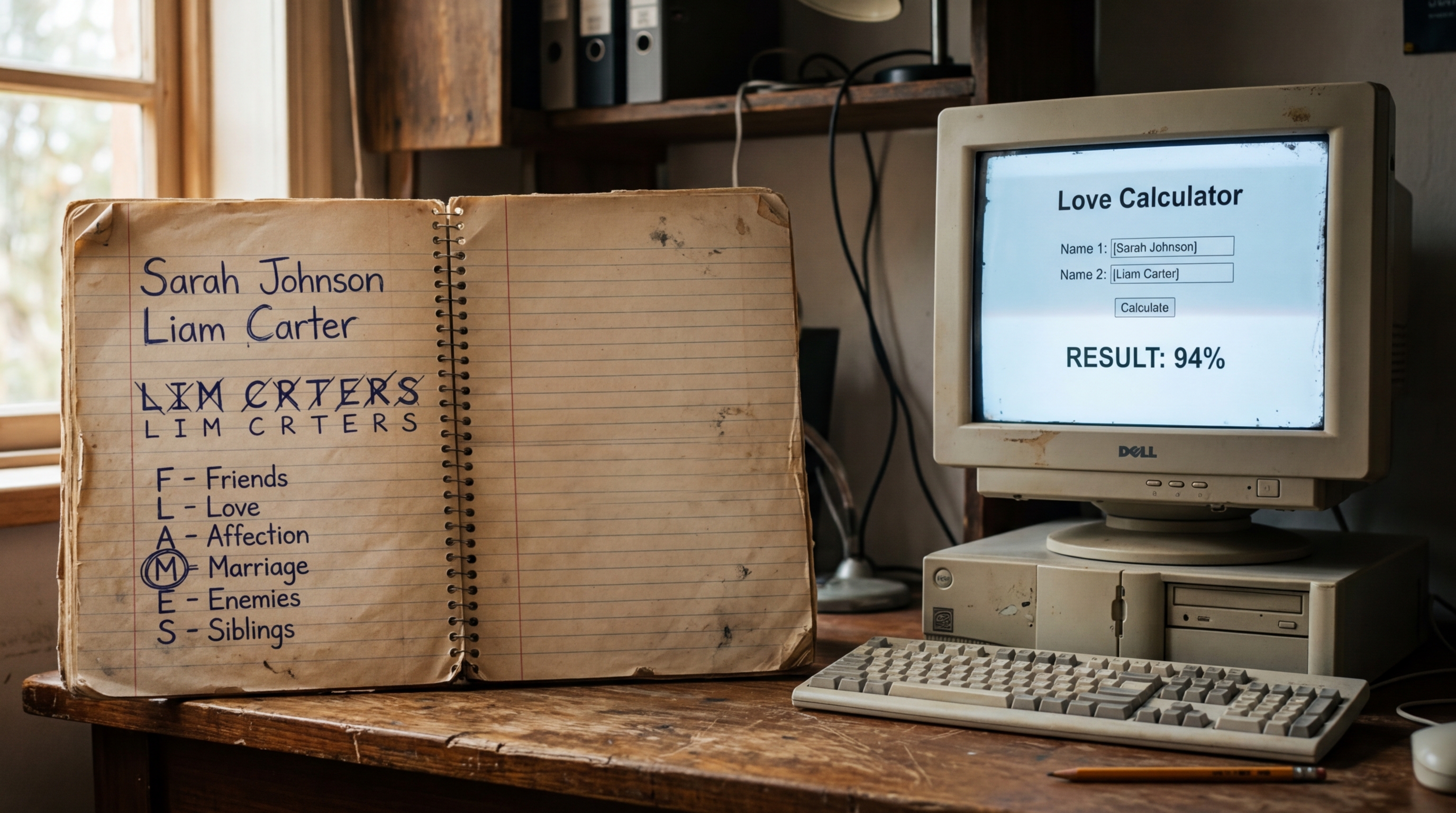
Most people assume love calculators are a product of the internet age — some quirky web developer's weekend project from around 2003. The reality is stranger and more revealing than that. The logic powering the majority of online love calculators today is older than the World Wide Web itself, and it was invented by bored middle schoolers with pencils.
That's not a knock on nostalgia. It's a diagnosis.
The Schoolyard Origins: Paper Games and the FLAMES Method
Before smartphones, before browsers, before personal computers were common household items, kids were calculating love compatibility on notebook paper. The most widespread method was FLAMES — an acronym standing for Friends, Lovers, Affectionate, Marriage, Enemies, Siblings. The game worked by writing two names, canceling out shared letters, counting the remaining letters, and then eliminating options from the FLAMES circle until one category remained.
This was the 1970s and 1980s. No algorithm. No database. Just a counting ritual that felt like fate because it was slightly more complex than flipping a coin.
FLAMES wasn't the only variant. There were regional versions involving heart diagrams, number-based counting games, and name-compatibility charts that circulated through schools the way memes circulate now — organically, kid to kid, with no traceable origin. The underlying logic in all of them was identical: take two names, apply a mechanical operation, produce a result. The result felt meaningful because the process felt deliberate.
That feeling — the sense that something systematic must be revealing something true — is the psychological engine that powered every love calculator that came after it.
The First Online Love Calculators (Late 1990s)
When the web went public and personal homepage culture exploded in the mid-to-late 1990s, love calculators were among the earliest novelty tools to appear online. The timing makes sense. Early web users were largely young, the medium was playful and experimental, and simple JavaScript made it easy to build an input form that returned a percentage.
The first wave of online love calculators did almost exactly what the paper games did: take two name inputs, run a deterministic formula (often based on ASCII character values or simple letter-counting), and return a number between 0 and 100. The percentage framing was new. It gave the output a veneer of scientific precision that the paper games lacked. But the underlying logic was structurally identical to FLAMES.
These tools spread through early link directories, school forums, and email forwards. They required no account, no personal data, and no thought. You typed two names, clicked a button, and got a number. The simplicity was the point.
Doctor Love: The Brand That Defined the Category
Among the early entrants, one name stuck: Doctor Love. The Doctor Love calculator — appearing in various forms across multiple domains throughout the late 1990s and early 2000s — became the category's defining brand. It had a name that implied expertise, a simple interface, and a result that came with a short interpretation. That combination was enough to make it memorable.
The "Doctor Love" branding was clever precisely because it was absurd. No actual doctor was involved. The title was a wink — a way of dressing up a novelty game in the costume of authority. And it worked. The name became so associated with online love calculation that "Doctor Love calculator" is still a search term people use today, decades after the original sites were built.
The Doctor Love brand also illustrated something important about this category: in the absence of real methodology, personality and presentation fill the gap. People didn't use Doctor Love because they believed it was accurate. They used it because it was fun, and because the name made the experience feel slightly more legitimate than it was.
What 'Doctor Love' Actually Calculated
The formula behind Doctor Love (and most of its contemporaries) was a name-based hash function — a mathematical operation that converted the characters in two names into a number. Specifically, many versions summed the ASCII values of the letters, applied some arithmetic, and mapped the result to a 0–100 scale.
The result was deterministic but arbitrary. Type the same two names and you'd always get the same score — which felt consistent, and therefore credible. But the score had no relationship to anything about the actual people. It was a function of their names as strings of text, not of their personalities, communication styles, values, or attachment patterns.
This is the original sin of the love calculator category, and it has never really been corrected.
How the Category Evolved — and Where It Stalled
Through the 2000s and into the 2010s, love calculators multiplied. Mobile apps appeared. Designs improved. Some tools added zodiac sign inputs, birthdate fields, or personality questions. A few incorporated numerology — using life path number compatibility as a proxy for deeper personality matching.
But the core logic barely moved. Most tools that added zodiac inputs, for instance, weren't running actual astrological compatibility analysis. They were running lookup tables — if Sign A and Sign B, return score X. The same reductive logic, dressed in new clothing.
Astrology, done seriously, is considerably more complex than that. What astrology says about the signs behind the names involves not just sun signs but the interplay of multiple placements — moon signs, Venus positions, Mars energy. A calculator that asks only for your sun sign and returns a compatibility percentage is doing roughly the same thing Doctor Love did in 1998, just with a zodiac wheel as decoration.
The same pattern holds for numerology, personality type inputs, and most other frameworks that love calculators have adopted over the years. The frameworks themselves have depth. The calculators implement them shallowly.
There's a structural reason for this stagnation. Love calculators are built to be frictionless. The value proposition is speed: two inputs, one output, instant gratification. Any methodology complex enough to produce genuinely meaningful results requires more than two inputs. It requires time, reflection, and data that people aren't going to type into a web form on a Tuesday afternoon.
So the category found its equilibrium at "fast and fun" and mostly stayed there.
What a Modern Love Calculator Should Actually Do
The question worth asking — especially now, when machine learning tools can process complex inputs and return nuanced outputs — is what a love calculator could do if it were built with actual rigor.
A few things would have to change fundamentally:
Input quality. Names alone tell you nothing about compatibility. Birthdates open the door to numerological and astrological analysis. Personality frameworks like attachment style or values alignment require questionnaire-style inputs. Any calculator serious about compatibility needs more than two text fields.
Methodology transparency. What is the calculator actually measuring? The original Doctor Love never said. Most current tools don't either. A credible tool would explain its framework — whether it's drawing on moon sign and Venus placement compatibility, numerological life path alignment, or something else entirely.
Probabilistic, not deterministic, outputs. Real compatibility isn't a fixed number. It's a range of tendencies, strengths, and friction points. A score of 73% means nothing without context. What does that score reflect? Where are the areas of natural alignment? Where are the likely conflict points?
Honest framing. The question of what a 100% love calculator score actually means is a good proxy for the category's broader honesty problem. A perfect score from a name-based hash function is a mathematical accident, not a romantic verdict. Tools that present their outputs as definitive are doing users a disservice.
None of this requires abandoning the fun, accessible nature of the format. But it does require treating the underlying question — are these two people genuinely compatible? — with more seriousness than a FLAMES game demands.
From Paper to Pixel: The Gap That Still Exists
Here's the uncomfortable through-line of love calculator history: the technology changed dramatically between 1978 and 2024, but the core methodology barely did. A kid circling FLAMES in a notebook and a user typing names into a modern love calculator app are doing functionally the same thing. They're applying a mechanical process to names and accepting the output as a signal.
The paper game was honest about what it was. It was a game. It existed to create a moment of shared excitement, to give two twelve-year-olds a reason to giggle about who they liked. Nobody walked away from a FLAMES game believing they'd discovered their soulmate.
Online love calculators — especially those with clinical-looking interfaces, percentage bars, and authoritative copy — are less honest. They wear the costume of analysis without doing the work. That gap between presentation and substance is what defines the category today.
The tools that will actually matter in this space — the ones worth using — are the ones that close that gap. Not by abandoning accessibility, but by grounding their outputs in frameworks that have genuine explanatory power. Astrology has that depth, if you go beyond sun signs. Numerology has it, if you engage with more than just name letters. Personality psychology has it, if you ask the right questions.
The history of love calculators is, in a way, a history of a question that never got a serious answer. The technology to provide one now exists. Whether the category will use it is a different question entirely.
If you're curious what it looks like when compatibility analysis is built on something more substantial than a name-count, see what a love calculator looks like when it's actually built on something real.
Or consider this: the most interesting compatibility frameworks — twin flame versus soulmate distinctions, composite chart analysis, attachment style mapping — share one thing in common. They treat the question of compatibility as genuinely complex. That instinct is worth preserving, whatever tools you use to explore it.