Zodiac Compatibility by Birthday: How Your Birth Date Shapes Your Love Match
Most people check their zodiac sign, look it up against their partner's, and call it compatibility research. That's like reading the cover of a book and claiming you know the plot.
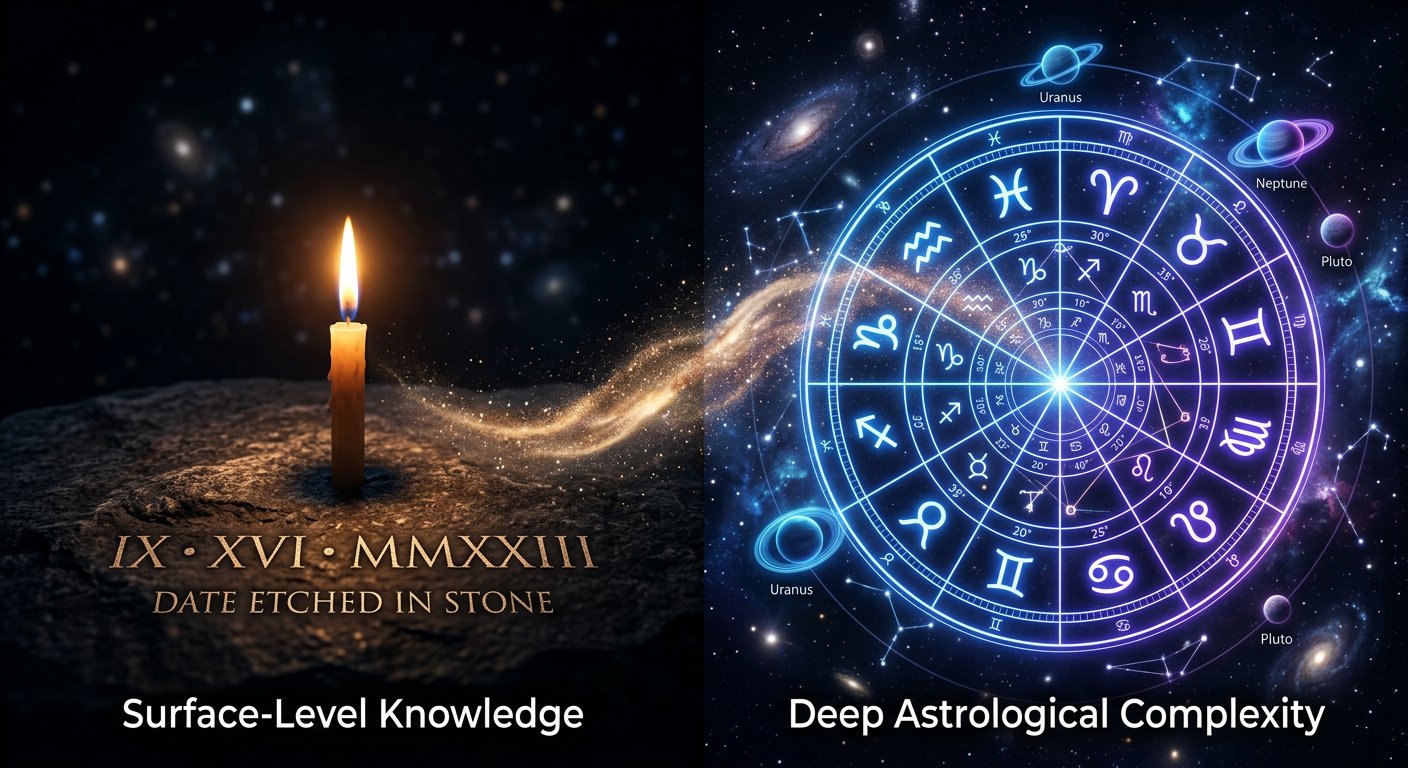
Your birthday carries far more information than just which of the twelve Sun signs you fall into. The specific day, month, and year you were born encode planetary positions, generational influences, and decan modifiers that completely change how compatibility plays out — and almost every casual zodiac chart ignores this entirely.
Here's the thing: two people can both be Scorpios but behave in radically different ways romantically, simply because they were born in different weeks of October or November, or in different decades. That's not a bug in astrology. That's the actual system working correctly — when you use the full system.
Why Your Birthday Holds More Compatibility Clues Than Just Your Sun Sign
The Sun sign is the entry point. It's not the destination.
When someone says 'I'm a Libra,' they're describing approximately 30 days of solar movement — roughly 1/12th of the year. That's a wide net. Millions of people share your Sun sign. The compatibility patterns assigned to that sign are real, but they're broad strokes applied to an enormous group.
Your actual birthday narrows this down significantly. The day tells you where you fall within your sign's three decan divisions. The month confirms your Sun sign. The year tells you which outer planets were in which signs during your formation — and those placements shape your relationship psychology in ways that last a lifetime.
Sun Sign vs. Full Birth Chart: What Your Birthday Actually Reveals
A full birth chart requires your exact birth time and location. A birthday alone — day, month, year — gives you access to a surprisingly detailed layer of information without needing that precision.
Here's what a birthday alone can tell you:
- Sun sign: Your core identity, ego, and conscious self-expression in relationships
- Decan placement: A sub-division of your sign that adds a secondary planetary ruler and behavioral modifier
- Outer planet signs: Uranus, Neptune, and Pluto positions based on your birth year, which define generational relationship values
- Approximate numerological pattern: The day of birth adds a numerological layer many astrologers cross-reference
And here's what it can't tell you without birth time: your rising sign, exact Moon sign (if you were born near a Moon sign change), or house placements. Those require precision. But don't underestimate what a birthday alone reveals — it's more than most compatibility articles account for.
For the broader framework of how signs interact at the Sun sign level, the zodiac sign compatibility chart is the right starting point before you layer in birthday-specific nuances.
How the Day, Month, and Year of Your Birth Influence Love Compatibility
Think of your birthday as three separate data inputs. Each one adds a filter.
The month determines your Sun sign — the most discussed factor. The day modifies it through decan divisions and numerological resonance. The year places you within a generational planetary context that shapes your relationship values at a deep, often unconscious level.
Strip any one of those layers away and you're working with incomplete information.
Decan Divisions: How the Specific Week You Were Born Modifies Your Sign
Every zodiac sign spans 30 degrees of the ecliptic. Astrologers divide those 30 degrees into three 10-degree segments called decans. Each decan carries a secondary planetary ruler and behavioral qualities that meaningfully differ from the other two thirds of the same sign.
Here's how that works in practice:
Aries (March 21 – April 19)
- Decan 1 (March 21–31): Ruled by Mars. Pure Aries energy — direct, impulsive, competitive.
- Decan 2 (April 1–10): Co-ruled by the Sun. More Leo-like warmth, pride, and dramatic flair in love.
- Decan 3 (April 11–19): Co-ruled by Jupiter. More philosophical, restless, Sagittarius-adjacent.
A first-decan Aries and a third-decan Aries are both Aries. But their compatibility profiles with, say, a Libra are measurably different. The first-decan Aries butts heads with Libra's indecision in a hot-and-cold pattern. The third-decan Aries, with Jupiter's influence, may find Libra's social grace genuinely appealing rather than frustrating.
This plays out across all twelve signs. Decans aren't a minor footnote — they're a legitimate compatibility modifier that birthday-based analysis can access without a full birth chart.
(In my experience working with client compatibility reads, decan mismatches explain a lot of the 'we're the same sign, we should work, but we don't' cases.)
Birth Year and Outer Planets: The Generational Compatibility Factor
Uranus, Neptune, and Pluto move slowly. Really slowly. Pluto can spend 12 to 31 years in a single sign. Neptune averages about 14 years per sign. Uranus moves through a sign in roughly 7 years.
Because of this, everyone born within a multi-year window shares the same outer planet sign placements. These are called generational planets for exactly this reason — they define cohort-level psychology, including how an entire generation approaches intimacy, commitment, and relationship rebellion.
A person born in 1990 has Neptune in Capricorn — a generation that tends to idealize stable, structured love. A person born in 1997 has Neptune in Aquarius — a generation more likely to idealize unconventional, freedom-forward partnerships.
When two people from different Neptune generations get together, they're often working from fundamentally different romantic blueprints — without realizing it. This isn't insurmountable, but it's a real compatibility factor that birthday year reveals instantly.
Similarly, Pluto in Scorpio (roughly 1983–1995) vs. Pluto in Sagittarius (1995–2008) creates distinct patterns around power, transformation, and what feels 'deep' in a relationship. Comparing birth years as part of compatibility isn't astrological trivia — it's structural.
For a more detailed look at how Venus and Mars placements (also birth-year-influenced) affect romantic drive, Moon Sign, Venus, Mars, Rising: The Four Placements That Actually Drive Romantic Compatibility covers the mechanics well.
Reading a Basic Zodiac Compatibility Chart Using Only Birthdays
You don't need a professional astrologer to start reading birthday compatibility. You need a method.
Step-by-Step: Finding Your Compatibility Score from Two Birthdates
Step 1: Identify both Sun signs from birth dates. Use the standard zodiac calendar. Confirm whether either person's birthday falls on a cusp (within 2 days of a sign change) — if so, you'll need to verify with a birth chart calculator, since cusp placements depend on the exact year.
Step 2: Determine the decan for each person. Divide each sign's 30-day span into three roughly 10-day blocks. Note which decan each birthday falls in and identify the secondary ruling planet for each.
Step 3: Check the Sun sign compatibility baseline. Look at the elemental relationship between both Sun signs. Fire-Air combinations tend toward intellectual excitement and volatility. Earth-Water combinations often create emotional security with occasional stagnation risk. Fire-Water pairings generate intensity and friction. Earth-Air pairings can feel disconnected unless other factors bridge the gap.
Step 4: Compare birth years for outer planet alignment. Are both people from the same Neptune generation? Same Pluto cohort? If yes, they share foundational romantic values even if their Sun signs clash. If not, note the ideological gap and factor it in.
Step 5: Use a tool to cross-reference. A love compatibility calculator by date of birth can automate steps 1–3 and give you a baseline score to work from. Treat it as a starting framework, not a verdict.
What the Numbers Mean — and What They Don't
Compatibility percentages from birthday-based tools reflect pattern matching — how frequently two sign combinations report relationship satisfaction, communication ease, or long-term stability in aggregated data.
A 90% score doesn't mean effortless. A 45% score doesn't mean impossible.
What the numbers actually tell you: the statistical baseline for that pairing. What they don't tell you: individual growth capacity, shared values built through experience, or the specific decan and generational nuances that could shift that number significantly in either direction.
For a clear breakdown of what percentage scores actually communicate, What a 100% Love Calculator Score Actually Means (And Why You Should Want 72%) is worth reading before you put too much weight on any single number.
The Limits of Birthday-Only Compatibility Readings
Be honest about what you're working with.
A birthday gives you Sun sign, decan, and generational outer planet data. That's genuinely useful. But it doesn't give you:
- Rising sign: The first impression you project and how you instinctively approach new relationships
- Moon sign: Your emotional needs, attachment style, and what you need to feel safe with someone
- Venus placement: How you express affection and what you find attractive
- Mars placement: Your drive, conflict style, and physical compatibility instincts
- House placements: Which life areas are activated in the relationship
The Moon sign alone is arguably more important than the Sun sign for long-term romantic compatibility. Two people can have perfectly compatible Sun signs but incompatible Moon signs — and the relationship will feel chronically emotionally unsatisfying despite surface-level chemistry.
Birthday-only readings are a legitimate starting point. They're a poor ending point.
If you're serious about a relationship, a full synastry chart (comparing two complete birth charts) is the proper tool. Birthday compatibility is the trailer. The full chart is the film.
How to Use a Love Calculator by Date of Birth Responsibly
Love calculators that use birthdays are genuinely useful — when you use them correctly.
Here's what responsible use looks like:
Use it for exploration, not confirmation. If you're hoping a calculator validates a relationship you're already invested in, you're using it wrong. Use it before you've formed a strong emotional attachment to the result.
Compare multiple pairs. Run your birthday against several people you know well. Does the output match your actual experience with those people? If yes, the tool is calibrated in a way that resonates with your chart. If not, adjust your interpretation accordingly.
Treat it as a conversation starter. The most useful thing a birthday compatibility reading does is give you specific questions to explore. If it flags communication as a friction point, that's worth discussing — not as a problem to solve, but as a dynamic to be aware of.
Don't use it as a veto. Ending or avoiding a relationship because a calculator returned a low score is allowing a tool to substitute for your own discernment. Astrology is a framework for self-knowledge, not a decision-making machine.
And look — if you're curious where numerology fits into all this, Numerology and Love: What Your Life Path Number Says About Who You're Compatible With adds another birthday-derived layer worth exploring alongside zodiac readings.
Frequently Asked Questions About Birthday Compatibility
Can two people with the same birthday be compatible? Yes — and it's more nuanced than it sounds. Shared birthdays mean shared Sun signs and decans, but birth years may differ, creating different generational planet placements. Same-birthday couples often share core values and communication styles but can clash on the exact relationship structure each envisions (the generational gap at work).
Is zodiac compatibility by birthday accurate? It's a real signal, not a definitive verdict. Sun sign and decan compatibility patterns are documented across centuries of astrological tradition and have meaningful overlap with modern psychological compatibility frameworks. But accuracy increases significantly when you add Moon sign, Venus, and Mars data — which require birth time.
What if someone doesn't know their exact birth time? Birthday-only tools are specifically designed for this situation. You get Sun sign, decan, and generational data without needing the exact time. For Moon sign precision, some calculators can narrow it down if the Moon wasn't changing signs that day — which happens about 85% of the time.
Do decans really matter for compatibility? I think they matter more than most people realize. They're the most commonly overlooked birthday-derived compatibility factor. Before you conclude that a sign pairing 'just doesn't work,' check whether you're comparing the same decans or different ones. The answer often changes.
Is a birth date love match the same as a full synastry reading? No. A birth date love match is a subset of what synastry covers. Think of it as the first chapter. A full synastry comparison using two complete birth charts covers all planetary placements, aspects between charts, and house overlays. That's the full picture.
Where should I start if I want to go deeper? Start with your zodiac sign compatibility chart baseline, then run both birthdays through a love compatibility calculator by date of birth to get a scored starting point. From there, add birth time if you have it, and move toward a full synastry read.
What to Actually Do With This Information
Your birthday is a starting point — a surprisingly rich one.
Sun sign gives you the headline. Decan gives you the subheading. Birth year gives you the generational context. Together, those three layers from a single date produce a compatibility profile that goes well beyond 'are you a compatible sign?'
But don't stop at the birthday. If a reading sparks curiosity about a relationship, use it as motivation to go deeper — add Moon sign data, explore the outer planet comparisons, and eventually work toward a full chart comparison if the relationship matters enough.
The birthday is the door. What's interesting is what's on the other side.