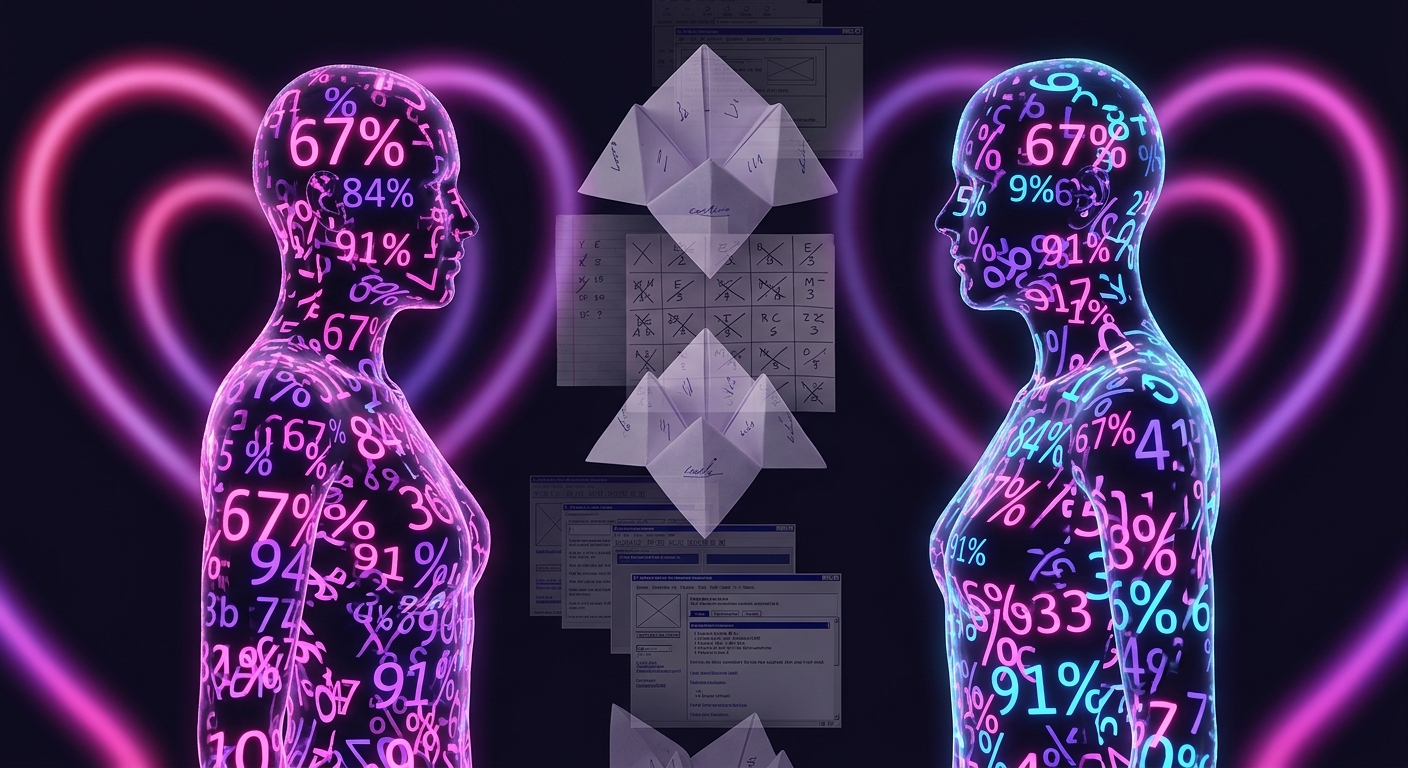
There's something almost hypnotic about a single number appearing on screen after you type two names. 67%. 84%. 91%. It feels like a verdict. And for millions of people who've typed their name next to a crush's name into a love calculator, that number has landed with surprising emotional weight — even when everyone involved knew, on some level, that it was just for fun.
But here's the thing: that percentage has a real history. It didn't appear out of nowhere. The 0–100 scale, the name-input format, the way results are displayed — all of it traces back through a surprisingly long chain of playground games, early internet quirks, and deliberate design decisions. Understanding the full history of love calculators from paper to algorithm puts the percentage in context. And once you see where it came from, you'll understand both why it resonates so deeply and why it should never be mistaken for truth.
Let's trace that number from the schoolyard to your screen.
Common Misconceptions About Love Calculator Percentages
Before getting into the history, it's worth clearing up a few myths that keep circulating — especially among people who treat their love calculator result as something more than entertainment.
Myth 1: The percentage is based on real compatibility science. It isn't. No peer-reviewed research in relationship psychology produces a 0–100 compatibility score from two names. The percentage format borrows the visual authority of scientific measurement, but the underlying inputs — names, birthdates, initials — have no validated connection to relationship outcomes. Actual relationship researchers focus on attachment styles, communication patterns, and value alignment. None of that fits neatly into a text box.
Myth 2: Higher percentages mean better relationships. This one's surprisingly persistent. In my experience watching people interact with compatibility tools, there's a real tendency to feel disappointed by a 72% and thrilled by a 95% — as if the relationship itself changes based on the output. The score doesn't measure the relationship. It measures an algorithm's response to character strings.
Myth 3: All love calculators use the same formula. They definitely don't. Some use letter-counting methods derived from the FLAMES game. Others use numerology-based digit reduction. Some modern tools layer in astrological data, birth chart elements, or even behavioral survey scores. The fact that they all display a percentage creates an illusion of standardization that simply doesn't exist.
Pre-Digital Scoring: How Playground Games Assigned Love Numbers
The FLAMES Game and Letter-Counting Methods
Long before anyone had a personal computer, kids were calculating romantic compatibility with nothing but a pencil and a piece of notebook paper. The FLAMES game — an acronym standing for Friends, Lovers, Affectionate, Marriage, Enemies, Siblings — was one of the most widespread versions. You'd write two names, cross out shared letters, count what remained, and cycle through the FLAMES categories until one survived.
FLAMES didn't produce a percentage. It produced a category. But the underlying logic — take two names, apply a counting rule, output a romantic verdict — is exactly the same logic that powers modern love calculators. The game taught a generation of kids that names contain hidden information about relationships, a belief that proved remarkably sticky.
Letter-counting variations went further. Some versions assigned numeric values to letters (A=1, B=2, and so on), summed the values for both names, and compared totals to determine compatibility. The result was often expressed as a fraction or a rough score. So the leap to a clean percentage wasn't a giant conceptual jump — it was more like a formatting upgrade.
Paper Fortune Tellers and Numeric Compatibility Wheels
Parallel to FLAMES, paper fortune tellers (sometimes called cootie catchers) were another pre-digital compatibility tool. These folded paper devices used numbers and colors to generate answers to questions — including romantic ones. The outputs were categorical ('yes,' 'no,' 'maybe') rather than numeric, but they established the same ritual: input two people, receive a verdict.
Numeric compatibility wheels appeared in teen magazines through the 1970s and 1980s. These were printed charts where you'd look up your birth month and your crush's birth month, find the intersection, and get a compatibility score — often expressed as a number out of 10 or a star rating. This is actually pretty close to a percentage, just with a smaller scale. The design instinct was already there: reduce romantic potential to a single, scannable number.
Doctor Love's Algorithm: The First Widely Recognized Percentage Formula
How the Original Formula Converted Names Into a Score
When the internet became publicly accessible in the mid-1990s, someone had the idea to port the name-counting game to a webpage. The "Doctor Love" calculator — one of the earliest and most widely replicated versions — became something of a template for everything that followed. You can explore more about this in resources covering love score algorithm history.
The Doctor Love formula worked roughly like this: count the occurrences of specific letters in both names combined, apply a formula that weighted certain letter combinations, and output a number between 0 and 100. Different implementations used slightly different counting rules, but the core approach was consistent. The formula was deterministic — the same two names would always produce the same score — which gave it a feeling of objectivity even though the rules were entirely invented.
What made Doctor Love culturally significant wasn't the math. It was the distribution. The tool was built to generate plausible-feeling results — mostly in the 40–85% range — rather than clustering everything near 50% or maxing out at 100% for common name pairs. That distribution felt realistic. It felt like the calculator actually knew something.
Why 0–100% Became the Universal Output Format
This is actually a really interesting design question. Why not 1–10? Why not a letter grade? Why not a categorical result like FLAMES?
The percentage format won for a few reasons. First, percentages are culturally legible in a way that arbitrary scales aren't. Everyone understands that 100% is perfect, 0% is nothing, and 73% is... pretty good, maybe? The scale carries intuitive meaning without any explanation required.
Second, percentages allow for fine-grained differentiation that feels personal. A result of 78% feels different from 79%, even if the underlying calculation treats them identically. That specificity creates the impression of precision — of measurement rather than guessing.
Third, and I think this is underrated: percentages are easy to compare and share. 'I got 84% with him!' is a complete, communicable statement. It invites conversation. It's inherently social. For a tool that spread primarily through word of mouth and early social sharing, that shareability was huge.
How Different Eras Interpreted What the Percentage Meant
1990s Web Calculators: Pure Entertainment, No Pretense
The early web love calculators were honest about what they were: novelties. The design aesthetic was deliberately campy — flashing hearts, Comic Sans typography, pixelated cupid icons. Nobody who used a 1990s love calculator was confused about whether it was scientific. The entertainment value was the point.
This era produced some genuinely creative implementations. Some calculators included disclaimer text that was funnier than the result itself. Others generated different outputs on different days for the same name pair, just to keep things interesting. The percentage was clearly a prop in a bit of playful theater.
2000s Tools: Adding Pseudo-Scientific Framing
Something shifted in the early 2000s. As the internet matured and users became more sophisticated, love calculators started dressing up their outputs with scientific-sounding language. Results pages began including phrases like 'our algorithm analyzes the vibrational frequency of your names' or 'based on established compatibility research.' The percentage stayed the same, but the framing changed.
This wasn't unique to love calculators — it reflected a broader web trend of adding authority signals to entertainment content. But it did create a generation of users who were slightly less sure whether they were playing a game or receiving real information. The ambiguity was, at least partially, intentional.
Modern Calculators: Layering Astrology and Numerology Into the Score
Today's love calculators often incorporate multiple inputs: names, birthdates, zodiac signs, sometimes even moon signs or rising signs. The percentage output now frequently represents a composite score — part name-based calculation, part astrological compatibility, part numerology scoring. If you're curious how those astrological layers affect perceived compatibility, it's worth looking at how moon sign, Venus, Mars, and rising sign placements drive romantic compatibility.
This layering does add genuine conceptual complexity, even if the underlying math remains somewhat arbitrary. A calculator that considers both a Scorpio-Gemini pairing and the numerological values of both names is doing more work than Doctor Love's simple letter count. Whether that additional work produces more meaningful outputs is a different question — but it does explain why modern percentages often feel more personalized than their 1990s ancestors.
Practical Tactics for Understanding Love Score Design
| Technique | Best Use | Outcome |
|---|---|---|
| Letter-frequency counting | Name-based calculators, FLAMES-style tools | Produces consistent, deterministic scores from character data |
| Digit reduction (numerology) | Birthdate and name calculators | Converts any number to a single digit or percentage via iterative addition |
| Astrological element matching | Tools that accept zodiac sign inputs | Generates compatibility score based on fire/earth/air/water element interactions |
| Survey-based scoring | Modern relationship assessment tools | Weights behavioral and values questions to produce a composite percentage |
| Randomized range seeding | Entertainment-first calculators | Uses name as a seed for a pseudo-random number in a defined range, ensuring variety |
| Composite score averaging | Multi-input modern calculators | Combines multiple sub-scores (numerology + astrology + name) into a single percentage |
Can You Actually Get 100%? What a Perfect Score Has Historically Meant
When 100% Is Mathematically Possible
Short answer: yes. In most name-based calculators, 100% is mathematically achievable. If you're curious about what that actually means and whether you should even want it, there's a great breakdown at what a 100% love calculator score actually means.
In the original Doctor Love-style formula, certain name combinations produce a remainder of zero when the letter counts are processed, which maps to 100%. It's not common, but it's not impossible either. If you run enough name combinations, you'll eventually hit it. Some users spend considerable time doing exactly this — treating the calculator as a puzzle to solve rather than an oracle to consult.
Why Most Calculators Cap or Skew Results
Here's an interesting design choice that most users never notice: many modern love calculators are deliberately calibrated to avoid very high percentages. Results above 95% are rare not because the math makes them rare, but because designers discovered that implausibly high scores actually reduce user trust and engagement.
A 99% result feels fake. It breaks the spell. Users think 'this is clearly just generating random high numbers' and dismiss the tool entirely. A 78% result, on the other hand, feels specific. It feels earned. It leaves room for interpretation and discussion. So designers intentionally weight their outputs toward the 55–88% range, where results feel meaningful without feeling inflated.
This is a genuinely clever piece of UX psychology, and it says something interesting about how we interact with numeric information. We don't actually want the highest possible score — we want a score that feels credible.
Measuring Success: What Makes a Love Calculator Score Feel Meaningful
From a design and engagement perspective, love calculators are measured by metrics that have nothing to do with accuracy:
- Return rate: Do users come back to check different name combinations? High return rates indicate the tool feels engaging and variable enough to reward repeated use.
- Share rate: Do users share their results? This is the primary growth mechanism for viral love calculators and indicates the result felt worth discussing.
- Session depth: Do users try multiple combinations in a single visit? This suggests the scoring range feels plausible and interesting rather than random.
- Benchmark: Successful entertainment calculators typically see 3–5 name-pair attempts per session, with share rates of 15–25% on mobile platforms.
None of these metrics measure whether the calculator told users anything true about their relationships. And that's fine — because that was never the actual product. The product was the emotional experience of being given a number and deciding what to do with it.
What the Percentage Score Still Cannot Tell You
Look, this is important to say clearly: no percentage generated from names or birthdates can measure the things that actually determine relationship success.
Communication quality. Emotional availability. How two people handle conflict. Whether their long-term goals align. Whether they make each other laugh. Whether they show up when things get hard. These are the variables that relationship researchers actually study, and none of them are captured by counting the letters in 'Sarah' and 'Michael.'
So when someone asks whether love calculators have any predictive validity — whether a 40% result means a relationship is doomed — the honest answer is no. The percentage is a historical artifact, a design convention, a piece of interactive entertainment. It can be fun, it can be thought-provoking, it can be a conversation starter. But it's not a measurement of anything real about the two people involved.
If you want tools that engage more seriously with compatibility, the name vs. date-based approaches have meaningfully different histories and assumptions. And if you're curious how to interpret the scores you do get, understanding love calculator score interpretation helps put specific numbers in proper context.
Future Trends: Where the Love Percentage Is Heading
A few directions are already visible in the current landscape.
AI-generated personalized explanations. Rather than just displaying a number, newer tools generate a paragraph explaining why this particular pairing scored 73% — synthesizing astrological, numerological, and name-based factors into a narrative. The percentage becomes an entry point rather than a conclusion.
Multi-dimensional score breakdowns. Instead of one overall percentage, some tools now display sub-scores: emotional compatibility, intellectual connection, physical chemistry. This mimics the structure of actual psychological assessments and gives users more to engage with.
Integration with real behavioral data. Some experimental tools ask users a handful of actual questions — about communication preferences, conflict styles, values — and incorporate those answers into the final percentage. This blurs the line between entertainment and genuine reflection in interesting ways.
And honestly? I think the fundamental appeal of a single percentage isn't going anywhere. It's too efficient, too emotionally satisfying, too shareable. What will change is the richness of the story that surrounds that number.
Where That Number Actually Leaves You
The love calculator percentage has traveled a long way — from crossed-out letters on notebook paper to Doctor Love's mid-1990s web formula to today's multi-input composite scores. It's been dressed up as science, stripped down to pure fun, and everything in between. But the core experience has stayed the same: type two names, get a number, feel something.
That feeling is real, even if the number isn't precise. The percentage works because it gives you something to react to — a starting point for thinking about a relationship, a reason to smile or roll your eyes, a number to screenshot and send to a friend. Used that way, it's genuinely delightful.
So if you want to experience that for yourself, see your love compatibility percentage now — and now that you know where the number comes from, you can enjoy it with exactly the right amount of skepticism and exactly the right amount of fun.