Key Takeaways
(See full list at bottom of article)
Somewhere between the ancient astrologer charting Venus's position at the moment of your birth and the teenager typing two names into a website at 2am, hoping for a high score, there's a remarkably consistent human story. We want to know if this person — this person — is meant for us.
That desire is old. The tools we've built to answer it have changed shape many times. But when you trace the specific history of 'true love' and 'soulmate' calculators as a category, something interesting emerges: the methodology hasn't evolved nearly as much as the marketing has. And understanding why that branding resonated so deeply tells you more about human psychology than it does about romantic compatibility.
This is the story of how we got here.
The Human Need to Find 'The One': Why Soulmate Calculators Exist
The concept of a soulmate — a single person cosmically designated as your perfect match — has roots that predate the internet by several millennia. Plato's Symposium gave us one of the earliest articulations: the idea that humans were originally whole beings split in two, forever searching for their other half. That's a genuinely ancient framing, and it's done enormous cultural work ever since.
But here's the thing — the soulmate concept is psychologically potent precisely because it converts an overwhelming open question ('will I find lasting love?') into a search problem ('am I with the right person?'). If there's a destined match, then the anxiety of choice collapses into the comfort of recognition. You're not choosing; you're discovering.
That psychological function is exactly what true love calculators have always sold, even when they didn't use those words. For a fuller picture of how the broader category developed, the complete history of love calculators is worth reading — it covers the progression from paper playground games to algorithmic tools in useful detail. But the soulmate framing specifically has its own lineage, and it starts well before the digital age.
Ancient Predecessors: Divination Systems That Predicted Romantic Destiny
Long before anyone typed names into a text field, cultures around the world had developed systematic approaches to identifying destined romantic partners. These weren't casual guesses — they were formalized, often highly technical systems that carried real social authority.
Astrology's Role in Identifying Soulmate Connections
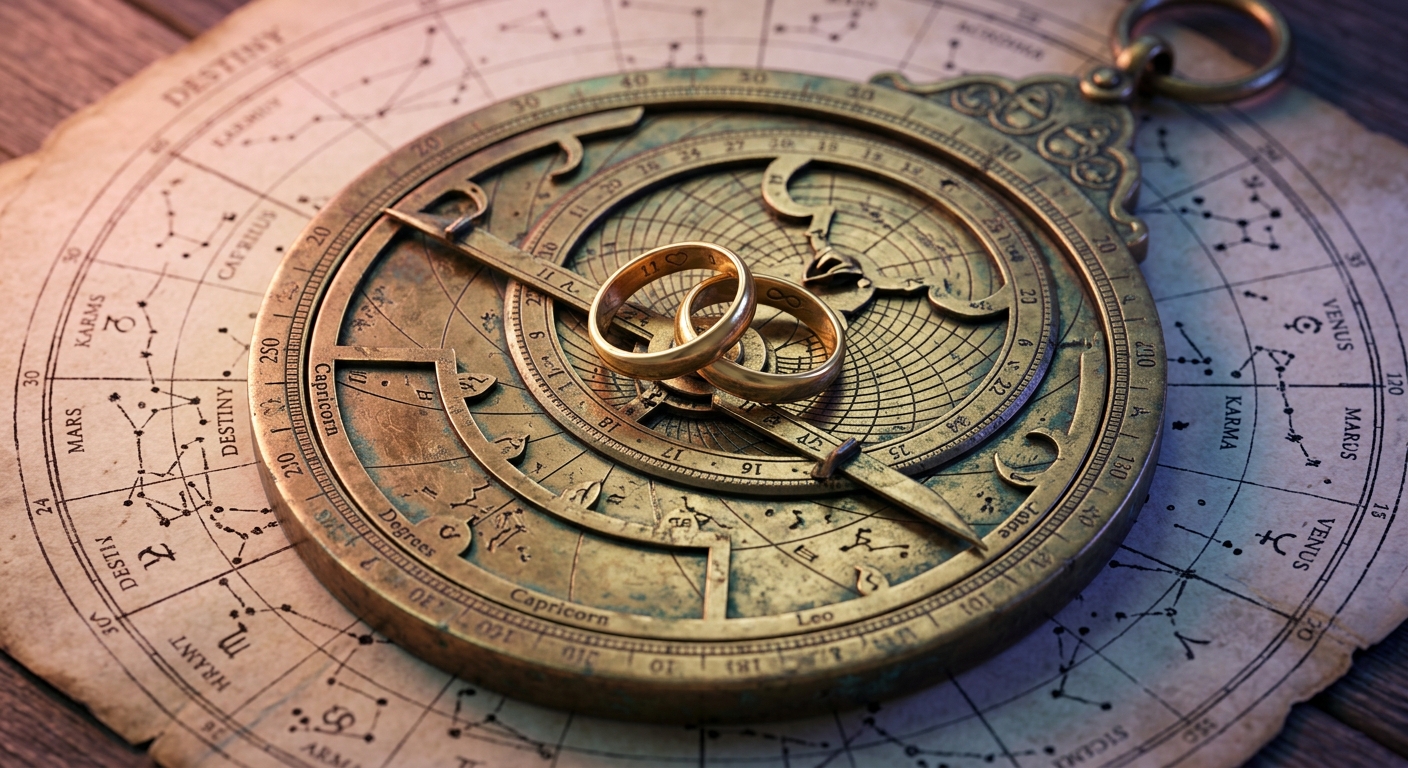
Astrology compatibility as a romantic diagnostic tool dates back at least to ancient Babylon, with significant development through Hellenistic astrology around 200 BCE. The premise was direct: the positions of celestial bodies at the moment of your birth shape your character, your desires, and your relational patterns. Compare two charts carefully enough, and you could identify natural harmony or friction.
The concept of synastry — overlaying two birth charts to examine how one person's planets interact with another's — became a sophisticated methodology over centuries. A synastry reading wasn't just checking if your sun signs matched. It examined Venus placements (what you find beautiful and lovable), Mars placements (how you pursue and express desire), and the angles between planets across two charts. If you want to understand how these placements actually function in modern compatibility thinking, Moon Sign, Venus, Mars, Rising: The Four Placements That Actually Drive Romantic Compatibility does a solid job unpacking the layers.
Critically, astrology already contained what we'd now call 'soulmate logic': the idea that two charts could be karmically connected, that certain aspects indicated a destined encounter. The north node in particular became associated with karmic relationships and soul-level connections — and that framework carried directly into modern tools. You can see this in how Composite Charts and the North Node: The Two Astrology Tools That Reveal Where a Relationship Is Going explains the north node's role in identifying relationship purpose and direction.
Numerology and the Concept of Destined Number Matches
Parallel to astrology, numerology developed its own framework for romantic destiny. Pythagorean numerology (attributed, perhaps loosely, to Pythagoras in the 6th century BCE) held that numbers carried vibrational essences, and that the numbers derived from your name or birthdate revealed fundamental truths about your character and your destined path.
The 'life path number' — calculated from your full birthdate — became the numerological equivalent of a sun sign: a core identity marker that could be compared to a partner's for compatibility. Certain number pairings were considered naturally harmonious; others were seen as challenging or transformative. The idea that your birthdate contains encoded information about who you're meant to love is ancient, but it flows directly into the birthdate-based soulmate calculators that became popular in the 1990s and 2000s. For a deeper look at how this system works in practice, Numerology and Love: What Your Life Path Number Says About Who You're Compatible With covers the mechanics well.
Both systems — astrology and numerology — were doing the same fundamental thing: converting personal data (birth time and place, or name and birthdate) into a compatibility judgment that felt objective because it was systematic.
How 'True Love' Branding Emerged in Digital Calculator Culture
The Marketing Shift From 'Compatibility' to 'Soulmate'
The early digital love calculators of the 1990s were mostly novelty items. They used simple algorithms — often variations on the FLAMES game (Friends, Lovers, Affectionate, Marriage, Enemies, Siblings) or basic name-to-number conversions — and they were presented as entertainment. Nobody seriously claimed they were measuring destiny.
The shift happened gradually through the late 1990s and accelerated in the 2000s, as the web became more commercially competitive. 'Compatibility calculator' was a functional description. 'True love calculator' was a promise. 'Soulmate percentage tool' was a story.
And stories convert better than functions.
So the vocabulary shifted. Tools that had been calculating name-number compatibility began describing their outputs in terms of soul connections, karmic bonds, and destined partnerships. The underlying math often didn't change at all — but the framing transformed how users interpreted results. A 73% compatibility score is interesting. A 73% soulmate match feels like confirmation.
Why Tools Added 'True' and 'Soulmate' to Their Names
Look, this was partly search optimization and partly genuine cultural responsiveness. As terms like 'soulmate' and 'true love' became dominant in romantic discourse — driven by films, pop music, and the early internet's romantic advice culture — users started searching for those specific terms. Tools that named themselves accordingly captured that traffic.
But there's something more interesting happening too. The addition of 'true' specifically is doing psychological work. It implies authenticity, depth, and permanence in a way that 'love calculator' doesn't. 'True love' is the kind worth finding; it's opposed to the false starts, the almost-right relationships, the comfortable-but-wrong partnerships. A tool that claims to identify true love is promising to cut through all of that.
That's a genuinely compelling promise. And it's one that the ancient divination systems had been making for thousands of years under different names.
What True Love Calculators Have Historically Claimed to Measure
Name Vibration and Karmic Connection Theories
Many soulmate calculators — particularly those built in the early 2000s — explicitly drew on numerological theory to explain their methodology. The idea was that names carry vibrational frequencies (each letter assigned a number, the numbers summed and reduced), and that compatible vibrations indicate a karmic connection.
The 'karmic' framing was doing specific work here. Karma implies a relationship that transcends a single lifetime — a connection that was established in a previous existence and is now being fulfilled. This is borrowed directly from Hindu and Buddhist philosophical frameworks, where karmic relationships are meaningful precisely because they carry obligations and lessons from past lives. Applied to a web calculator, it's a significant metaphysical claim dressed in friendly interface design.
I think what's genuinely interesting about this is that the karmic framing changes how users engage with the tool. If a result indicates a karmic connection, even a difficult score becomes meaningful — it's not a mismatch, it's a challenging but important relationship. The framing is almost impossible to falsify, which is exactly what made it useful for calculator branding.
Birthdate Destiny Numbers and Their Role in Soulmate Tools
Alongside name vibration, birthdate-based calculations became central to soulmate tool methodology. Destiny numbers (sometimes called expression numbers) calculated from full birthdates were compared between partners, with specific number combinations identified as 'soulmate pairings.'
This approach borrowed directly from ancient numerological tradition but packaged it for digital consumption. Users could enter two birthdates and receive a percentage score with an explanation referencing destiny numbers and compatibility patterns. If you want to explore how these birthdate-based approaches developed as their own subcategory, the history at /blog/love-calculator-history-by-date-of-birth-origin/ traces that lineage specifically.
The appeal was obvious: birthdate data feels more fixed and therefore more meaningful than something as changeable as a name. Your birthdate is immutable. If it indicates a connection, that connection feels written into the structure of reality.
The Psychology Behind Soulmate Calculator Popularity
Confirmation Bias and Why High Scores Feel Meaningful
Here's where the history gets genuinely illuminating. Research on confirmation bias — our tendency to seek and favor information that confirms existing beliefs — explains a significant portion of soulmate calculator psychology.
When someone uses a true love calculator with a person they're already attracted to, they're not approaching it neutrally. They want a high score. And because the tools typically produce scores across a wide range, they usually get something workable. A 68% is 'more than half, and compatibility takes work.' An 84% is 'we're clearly meant to be.' Even a low score gets rationalized ('the calculator doesn't know what we have').
Confirmation bias research suggests that people are roughly twice as likely to seek information confirming their existing beliefs than information that challenges them. Applied to soulmate calculators, this means users are primed to interpret results favorably — and the tools' vague, positive-leaning explanations make that easy. It's worth reading What a 100% Love Calculator Score Actually Means (And Why You Should Want 72%) for a practical examination of how score interpretation actually works.
The Comfort Function: What These Tools Provide Beyond Data
But I don't want to be reductive about this. The psychological function of soulmate calculators isn't just self-deception — it's also genuine emotional processing.
When someone is anxious about a relationship, uncertain whether their feelings are reciprocated, or grieving a connection that ended, these tools offer a moment of structured reflection. The act of entering names or birthdates, receiving a result, and reading an explanation is a ritual. And rituals — even secular, digital ones — serve real psychological functions. They externalize internal questions, create a sense of process, and provide a narrative frame for feelings that might otherwise be formless.
This is, incidentally, exactly what the ancient divination systems were doing. Consulting an astrologer about a romantic connection wasn't just about getting data. It was about having an expert help you make sense of your feelings within a structured framework. The tool has changed; the need hasn't.
Modern Soulmate Calculators: Are They Any More Accurate Than Their Predecessors?
Honestly? The answer is complicated, and it depends on what you mean by 'accurate.'
Modern soulmate and true love calculators generally fall into three categories. First, there are the novelty tools that use simple name-to-number or FLAMES-style algorithms — these are entertainment products and don't claim otherwise. Second, there are tools built on astrological or numerological frameworks — these are using ancient systems with genuine internal logic, even if that logic isn't scientifically validated. Third, and most recently, there are tools incorporating psychological frameworks — attachment style compatibility, love language matching, personality type assessments — that draw on actual relationship research.
That third category is genuinely newer. Attachment theory, developed through the work of John Bowlby and later Mary Ainsworth in the mid-20th century, provides a research-backed framework for understanding relational patterns. When modern calculators incorporate attachment style matching, they're using methodology that has empirical support in ways that name vibration theory doesn't.
But even the most sophisticated modern tool is working with limited data. Relationship compatibility is affected by timing, life circumstances, shared history, communication patterns, and dozens of other factors that no calculator can assess from a name and birthdate. If you're curious about exploring current tools in this space, you can find your soulmate compatibility score and see how these approaches have developed.
The honest version of what any soulmate calculator offers — ancient or modern — is a structured lens, not a verdict.
What History Tells Us About the Limits of Quantifying Destiny
Tracing the true love calculator soulmate history leads to a conclusion that's maybe counterintuitive: the tools matter less than the questions they help people ask.
The ancient astrologer and the modern website are both responding to the same human need — to make sense of romantic connection within a framework that feels larger than chance. The 'soulmate' branding that emerged in digital culture wasn't a cynical marketing invention layered onto neutral tools. It was a natural evolution of language that humans had been using for centuries to describe experiences that feel fated, meaningful, and irreducible.
And the history of these tools also reveals the limits of quantification. Compatibility — the real kind — isn't a percentage score. It's built through time, effort, honesty, and luck in proportions that vary for every relationship. The tools we've built to predict it are more accurate as maps of our anxiety than as maps of our future.
So what do you do with that? I think the useful move is to engage with these tools as the structured reflection exercises they actually are, rather than the predictive instruments they claim to be. Use a soulmate calculator the way you'd use a horoscope — not as a verdict, but as a prompt. Let it surface questions. Let it name feelings you hadn't articulated. And then take those questions into the actual, unpredictable, irreducibly human work of building a relationship.
For context on how these tools have evolved across different methodological approaches, the overview at /blog/love-calculator-history-free-tools-evolution-origin/ covers the technical development arc in more detail. And if you're specifically interested in the twin flame versus soulmate distinction — which carries its own historical weight — Twin Flame or Soulmate? The Difference Is More Important Than Most People Realize unpacks that conceptual split usefully.
The history of trying to quantify destiny is, ultimately, a history of trying to be less afraid. That's not a small thing. It just means we should be honest with ourselves about what these tools can and can't tell us.
Key Takeaways
- The 'soulmate calculator' category is primarily a branding evolution — the shift from 'compatibility' to 'true love' language changed how users interpreted results without necessarily changing the underlying methodology.
- Ancient divination systems including astrology and numerology were already performing the same core function as modern soulmate calculators: converting personal data into a compatibility judgment that feels objective because it's systematic.
- The 'karmic relationship' framing used by many early digital tools was borrowed directly from Hindu and Buddhist philosophical traditions — and it was psychologically effective because it made even difficult scores feel meaningful rather than disqualifying.
- Confirmation bias plays a significant role in soulmate calculator popularity: users approaching these tools with existing attraction are primed to interpret results favorably, regardless of the actual score.
- Soulmate calculators serve a genuine psychological function as structured reflection rituals — the act of entering names and receiving a result externalizes internal questions and provides narrative framing for feelings, much like consulting an ancient divination system did.
- Modern tools incorporating attachment theory and personality frameworks represent a real methodological advance over name-vibration algorithms, but even these cannot assess the timing, circumstances, and communication patterns that most determine actual compatibility.
- The history of quantifying romantic destiny reveals more about human anxiety and the need for meaning than about the mechanics of love — and that's precisely why these tools have persisted across cultures and centuries.